United Mexican States
Cry MachoThe United Mexican States is both the territory Mike Milo must cross to reach Rafo Polk and a landscape that changes the character of his journey. He enters with a kidnapping assignment, limited Spanish, and a plan dependent on secrecy; the road south initially loosens his grip on that purpose, while the search in Mexico City makes the country feel vast and difficult to read. Near the end of the journey north, the border becomes a physical threshold Mike and Rafo intend to cross without using the official station.
Entry and the assignment
Mike enters the United Mexican States in a dark-blue panel truck supplied by Howard Polk. Though new and unusually powerful, the vehicle is meant to look conservative and inconspicuous. At the crossing between Laredo and Nuevo Laredo, Mike waits behind four cars while a border official checks papers and a guard inspects vehicles. Mike has spent nearly a day preparing his documents and believes they are in order. The one item that troubles him is the 3-IN-ONE oil can containing Acetoform. When the official asks his purpose, Mike says he is on vacation; the guard’s signal that the truck is acceptable eases the inspection, and the official sends him on with a deliberately jocular farewell.
The official entry is an early lesson in the difference between the account Mike gives and the work he is actually undertaking. Howard has hired him to bring Rafo back from the United Mexican States, and Mike understands that the task is to kidnap the boy from his mother. Yet the border crossing itself proceeds as a routine inspection rather than a confrontation. Mike’s careful papers, anonymous vehicle, and cover story establish the practical conditions of a mission whose success will depend on staying unnoticed.
The road south
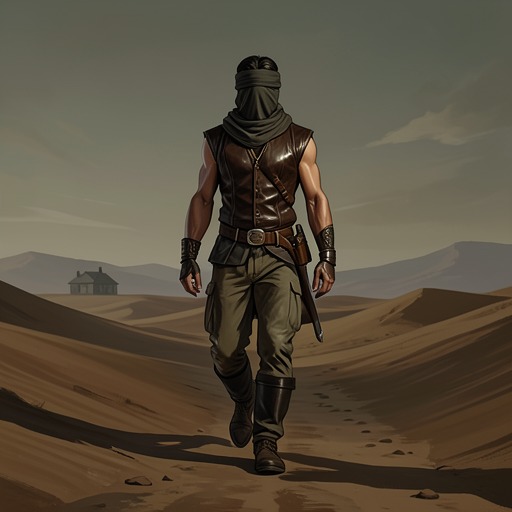
Howard has warned Mike that the first stretch of the Pan-American Highway, toward Monterrey, will be hot, flat, and miserable. Mike instead finds the desert exhilarating. Its wide emptiness gives him a temporary peace, and close attention to creosote, poppies, sage, and several kinds of cactus alters his sense of the landscape: the desert no longer seems merely a vacuum between towns. For a time, he feels less like a man on an abduction assignment than a traveler on vacation.
That ease is interrupted by a metallic rattle in the truck. Mike stops, checks beneath the hood and dashboard, and discovers that a loose strip of chrome is flapping against its metal clip. He repairs it with his tools, then drives away without the oil can. Realizing it is missing, he turns back to look for it. At first he finds nothing and takes that as a good omen; when he later finds the can, that too seems like a good omen. The small reversal captures the uneasy mixture of caution and superstition accompanying his passage: even an ordinary object can become a measure of how exposed he feels.
As the drive continues, Mike’s initial buoyancy diminishes. In Monterrey, he nearly buys two sleeping bags before remembering that only one is needed. In Linares, asked where he is going, he answers Tampico instead of Mexico City, then recognizes the lie as useless. He resolves to be more guarded, including about food and water, because illness could compromise the undertaking. The country’s distance is thus registered not only in miles but in the practical vigilance Mike must sustain while traveling alone.
Mexico City and the search
Three days after leaving Laredo, Mike passes the Green Indian statues Howard had mentioned and knows he has reached Mexico City. He follows Avenida Insurgentes, passes housing projects and a spired skyscraper, crosses a viaduct over the railroad station, and reaches the monument to the Aztec chief Cuauhtémoc. Although he is close to his destination, he does not take the truck to the hotel. He leaves it in a public garage, takes a cab to Hotel Fifth Avenue, and checks in under his real name with his tourist card. The choice keeps the hotel from learning that he has arrived in his own vehicle or receiving a description of it.
The city defeats the confidence of a straightforward search. Mike knows neither its geography nor its language well enough to do more than point and gesture in conversation. By day he studies a map and searches alleys, back streets, dead-end vecindades, and slum footpaths rather than spending time at the city’s churches, palaces, and museums. He is looking for a boy whose photograph is five years old, and the sheer number of dark-haired, dark-eyed children makes recognition uncertain even before the crowds are considered.
At night, Mike follows the sparse leads Lexa has given him. He goes to the Frontón, a jai alai stadium in the Plaza de la República, but the scale and noise of the crowd make the search seem nearly absurd. The next night he goes from bar to bar, drinking Coca-Cola as he follows reports that Rafo has run errands at El Picador. These places show the city not as a sightseeing destination but as a network of crowded public venues, hidden passages, and fragmentary clues. Mexico City is where Mike’s assignment becomes an exercise in persistence without reliable knowledge: he must keep searching even when he cannot tell which face, street, or rumor will lead to Rafo.
The return toward the border
Later, after Mike and Rafo have traveled north, the landscape becomes a corridor toward the United States. In the night, their vehicles continue down a hill after a roadside encounter. They stop to wake a Pemex attendant and buy fuel, paying an exorbitant price, then drive on. Headlights pick out a sign placing them forty kilometers from the border; two hours later, another sign puts them only two kilometers away. They stop there, approaching the boundary without yet passing through it in the scene described.
The planned crossing is deliberately outside the official station. Mike tells Rafo that they will leave the truck about a mile from the border, descend into a ravine, and emerge in Texas. The explanation is meant to calm the boy, who fears being asked for his papers; Rafo gives a small nod, accepting that he will have to manage his fear. The United Mexican States therefore frames both ends of Mike’s journey: he enters under a cover story to find a child and leaves by a concealed route with that child. Its roads and border crossings shape the practical suspense, while the contrast between Mike’s first, unexpectedly restorative desert drive and the tense approach north marks how much the mission has changed.